
Caffeine for Enhanced Carbohydrate Absorption (#83)
How does caffeine influence the body's ability to absorb and utilize carbohydrates during endurance sports? Here we explore what research has to say about the combination of caffeine and sports drinks, and why this is compelling for those looking to enhance endurance when sessions or races become lengthy. We're diving into optimization here. The evidence is undeniably clear that increased carbohydrate intake and absorption lead to improved performance in endurance sports lasting 90 minutes or more. There's also proof that carbohydrate intake for durations up to 60–90 minutes is beneficial, likely due in part to central or mental effects on the brain. However, the dosage is critical. An excessive amount can have negative consequences that outweigh the benefits. The conclusion is straightforward: caffeine can be a valuable tool, but it needs to be used with precision.
Background
Caffeine aids in carbohydrate absorption
A crossover study from the year 2000 tested the combination in a relatively small dose. Ten males cycled for 90 minutes at 70% of their max watts. They consumed 30 g of carbohydrates per hour together with 1.4 mg of caffeine/kg body weight. The results showed that glucose absorption through the gut membrane was more efficient with sports drink+caffeine compared to a regular sports drink — as much as 23% more specifically. This doesn't mean you can automatically absorb 23% more glucose, but if the transporters become more efficient, it opens up the possibility for higher intake and fewer gut issues.
Higher doses – greater effect, greater risk
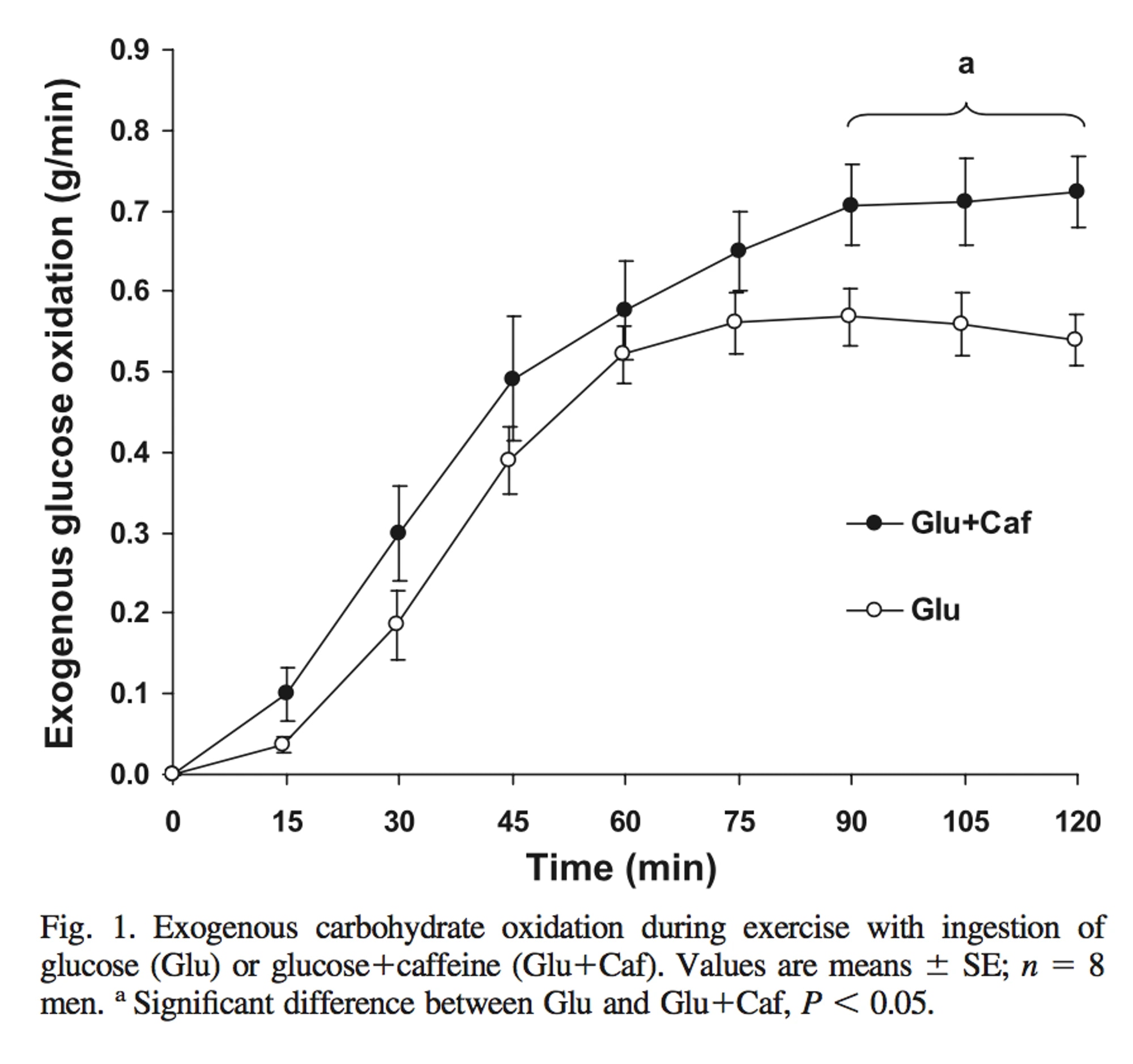
There's a clear linear relationship between increased carbohydrate absorption and enhanced performance. In a study conducted in 2005 by Jeukendrup et al, participants cycled for 120 minutes at 55% of their maximal watts. They consumed a sports drink with approximately 48 g of carbohydrates per hour along with 5 mg of caffeine per kg of body weight per hour (averaging 353 mg per hour). All participants performed the tests with either just water, just the sports drink, or the sports drink with caffeine.
Since they cycled for two hours and received this dose every hour, the total dose was 10 mg per kg of body weight (averaging 706 mg of caffeine). This is still within the safety range for humans but is also a dose where many start experiencing negative effects (such as feeling jittery, wired, nervous, and potential gut troubles—equivalent to about 8–10 large cups of coffee in two hours). The most exciting finding was that during the last 30 minutes, carbohydrate oxidation was 26% higher in the sports drink+caffeine group compared to just the sports drink. With caffeine in the sports drink, they oxidized an average of 0.72 g/min compared to 0.57 g/min with just the sports drink.
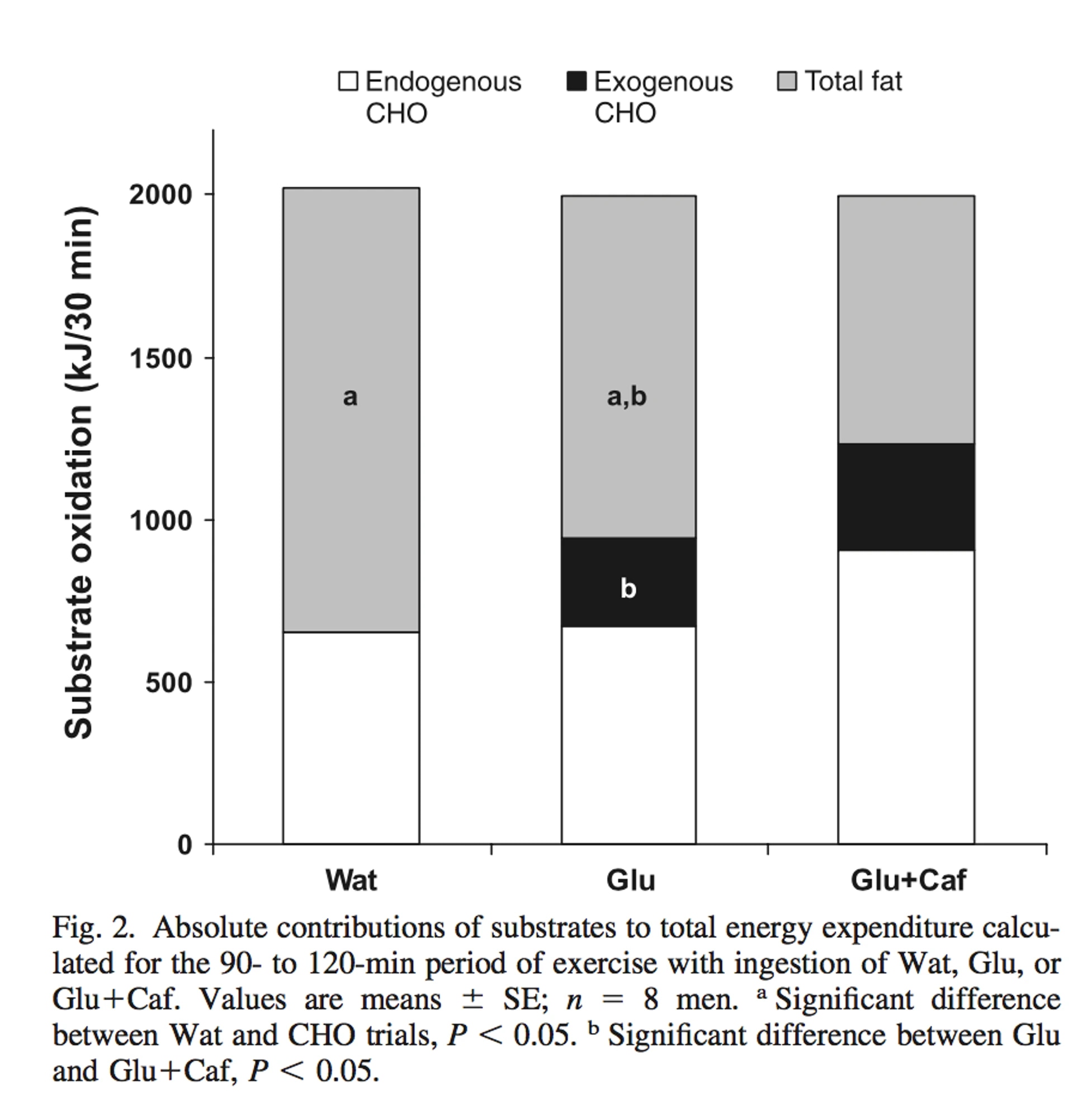
Those who consumed caffeine also oxidized more of their own glycogen stores, which can be debated as either positive or not. Oxygen consumption was lowest in the caffeine group, which makes sense since they oxidized carbohydrates to a greater degree, which are more energy-efficient. However, if they deplete their glycogen stores faster than those without caffeine, there's a risk of hitting the wall earlier if they can't maintain a high enough energy intake throughout. We certainly don't want to deplete glycogen stores faster than necessary.
Caffeine increases the release of both fat and glycogen stores (see graph below). Oxidizing more fat is beneficial as it conserves glycogen, but if glycogen stores are also depleted faster, there's a risk it might cause issues later in the session. Depleting your stores too quickly is problematic if your stomach starts acting up a few hours into a competition—you want to have as much glycogen left as possible to survive a period with low carbohydrate intake or just water until your gut settles.
Possible mechanism in the stomach
Caffeine seems to influence carbohydrate uptake by either activating more glucose transporters (especially SGLT-1) or by increasing the speed/efficiency of the existing transporters.
”The authors attributed their findings to a caffeine-induced increase in the glucose flux through SGLT1 into the enterocyte or GLUT2 transport from the enterocyte into the capillary. Direct evidence for a mechanism by which caffeine can increase intestinal glucose absorption is lacking. Caffeine inhibits the enzyme phosphodiesterase and therefore enables cAMP to remain active at the cell membrane for longer. cAMP has been shown to acutely increase glucose absorption via SGLT1 in the small intestine (52, 53), which could potentially lead to higher availability of CHO for oxidation.”
Caffeine boosts performance in various ways
Caffeine boosts your performance, an important aspect to keep in mind. In studies comparing sports drink+caffeine (the previously mentioned and this one from 2008), participants perform about 5% better with sports drink+caffeine (5.3 mg/kg body weight) than with just a sports drink, and about 10% better than with water. We also know that a proper sports drink with maltodextrin+fructose (2:1) compared to only maltodextrin allows participants to consume even more carbohydrates and, on average, perform 8–9% better than those who only consume maltodextrin. By combining these effects and creating a sports drink with a 2:1 ratio of maltodextrin to fructose and adding caffeine, we get a real rocket fuel when needed.
The 2008 study had the same intake of sports drink as the previously mentioned study from 2005 by Jeukendrup et al. The only difference was that the total caffeine intake was halved to 5 mg/kg body weight over a two-hour period instead of the 10 mg/kg body weight used in the earlier study. In the 2008 study, participants cycled for 105 minutes at 62% of VO2max, immediately followed by a 45-minute time trial. Those with caffeine + sports drink performed 4.6% better than those with just a sports drink and 9% better than those with water. The study was cross-over, so all participants did all tests with a few days of rest between.
It is worth noting that the carbohydrate oxidation/transport of carbohydrates did not significantly increase in this study. Both caffeine groups performed better, which may be due to several mechanisms (central effects, pain tolerance, etc.). Based on these two studies, it seems that caffeine can aid with carbohydrate uptake in the gut and oxidation, and that a fairly high dose is required — up to 10 mg/kg body weight over two hours — to achieve a noticeable effect.
The Dose Always Makes the Difference
Remember that the dose in the study with the best effect was 10 mg/kg body weight over two hours. For a 75 kg person, this corresponds to 750 mg in total, which means 375 mg/hour—a hefty dose. At lower doses, the effect hasn't been as significant, although there seems to be some effect; somewhere the dose becomes so low that the effect might only be a few percent. A percent can be enormous for those chasing margins, but probably a bit overly meticulous for many.
In short: if you're using caffeine to perk up and perform, it can be seen as an extra edge. It's a reason for those who haven't tried caffeine to give it a go—but test it during training first, so you know how your stomach and head react. For us, we mix U Sport and U Intend in the same bottle, as they are tastefully adapted to blend and allow for choosing the caffeine dose in the sports drink. But it also works fine with caffeine pills. You can also add a larger dose on 1–2 separate occasions for a clear kick. If continuous intake also helps carbohydrate transport, it's probably most beneficial to distribute the caffeine over time and maintain a certain level in the blood to both block fatigue and facilitate carbohydrate absorption.
Practical Conclusion for Training and Competition
We recommend a lower amount of caffeine in your sports drink throughout the race if it lasts more than 2-3 hours, but avoid large doses of caffeine if you're going to be out there for a while. Personally, we mix U Sport and U Intend in the same bottle as they are flavor-matched for blending and give you the option to choose the caffeine dose in your sports drink. Of course, caffeine pills work too. You can also take a larger dose at 1-2 specific instances for more of a kick effect. However, since a continuous intake helps with carbohydrate transport, it is likely most beneficial to distribute the caffeine over time, thus maintaining a certain level of caffeine in the blood to fend off fatigue and enhance/ease carbohydrate absorption.
The dose little and often applies to both carbs and caffeine when you want to perform!