
Heat training in warm clothing
A refreshing summary: Heat can impact your performance more than you might think—especially if you're competing in a hot climate. The question is whether you can acclimatize to heat at home, without needing to travel in advance. In this article, we explore what research and practical setups say about heat training, sweat response, and how the body adapts blood volume and temperature regulation. The conclusion is that you can achieve a lot with relatively simple methods, but the effects depend on dosage, execution, and how carefully you follow up to ensure you actually get "warm enough" over time.
You become good at what you train
The principle that you need to train for what you want to excel in is hardly a revelation, but sometimes it's easier said than done.
For example, if you're aiming for a fast time in an Ironman, you need to complete long training sessions in both cycling and running, and in the final phase, even brick sessions so your body is fully adapted to the challenge. We often say that you can't "hack" your way past the basics of a good athletic performance. Intervals and top-notch equipment are the icing on the cake when it really comes down to it.
Many small shortcuts become one fine…
That said, we love shortcuts—those little details that can give you a percent here and there. Together, these margins add up to a nice extra boost in your endeavor.
In this article, we take a closer look at how you can acclimatize to heat without needing to be on-site several weeks in advance. And honestly—who wouldn't want to be in Hawaii for two weeks before their Ironman 😅? Sometimes both budget and time are against us.
What do previous studies say?
Several studies have shown that heat training can increase the amount of red blood cells. Our red blood cells carry oxygen to the working muscles and are a limiting factor for maximum performance. With the help of heat training, you also increase your capacity to sweat. The body "buffers" more fluid as an adaptation to the heat, causing plasma volume to increase and red blood cells to become diluted. This dilution signals the body to produce more red blood cells via the hormone erythropoietin (EPO) to restore the relative proportion of blood cells.
Blood volume is dynamic and increases, among other things, from high training volume to a certain degree, which is also one of the reasons why volume in training has a significant function.
Altitude training has similar effects, but reduces plasma volume and thereby increases the amount of red blood cells. Altitude camps are one of the most popular options for development, but the question is whether heat training can gain increased focus in the coming years. It's an exciting area with lots of research ongoing!
The study in question
In a study by Carsten Lundby et al., they investigated whether similar heat acclimatization effects could be achieved by training with warm, non-ventilated clothes instead of training in hot conditions in a heat chamber or outdoors.
The setup:
Over 10 days, a group of cyclists were assigned to:
- Cycle 50 minutes in 35-degree heat.
- Cycle 50 minutes in wool base layer and rain gear.
- Cycle 50 minutes in wool base layer and rain gear AND bathe for 25–30 minutes in 40-degree water after training.
We particularly liked that last method. Just when you think you've sweat it all out, you jump into a hot pool — talk about taking the sweat party to the next level.
Rectal body temperature was measured with a goal of reaching at least 38.5 degrees. Participants drank 500 ml of fluid during the session, and intensity was adjusted based on perceived exertion (Rating of Perceived Exertion, RPE) over the days. It wasn’t intense training; the intensity was around 134–163 W for these elite cyclists with a VO2max around 75 ml/kg/min. So moderate exertion, staying around 12 on the Borg scale (somewhat hard), adjusting to maintain that level.
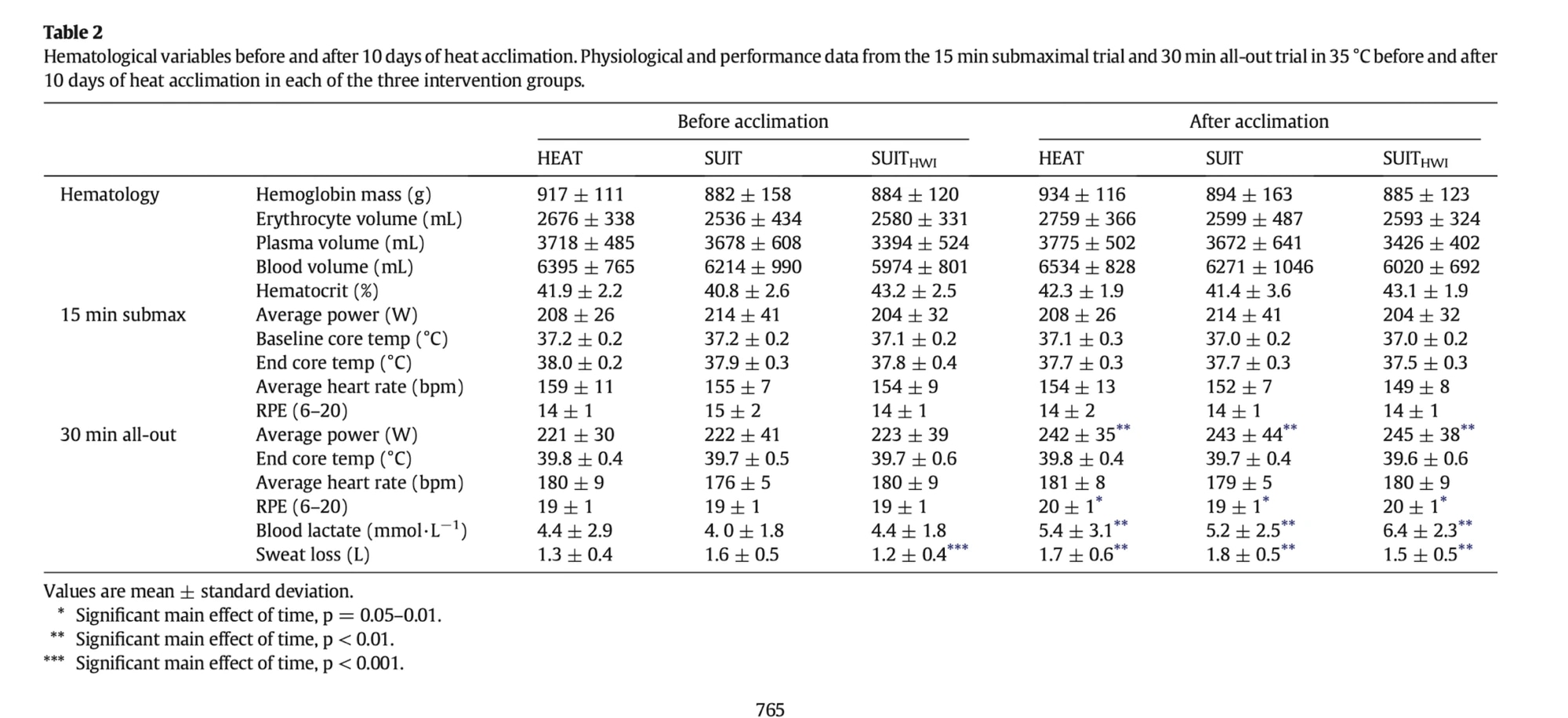
After the period, the same tests as before were conducted, and in a concluding 30-minute test in 35-degree heat, all groups increased their capacity by 9.5–10% in average power output.
Tests before and after the intervention
Lager 157 at camp. Photographer: Crelle
There wasn't a significant increase in red blood cell count, but researchers believe this was due to the short duration of the intervention. A trend was noted when all participants were grouped that showed an increase of about 9 g/person (1%) in red blood cells. Since the effects were so similar between training with clothing and heat training, it's reasonable to assume a longer intervention might have shown clearer results in red blood cell concentration.
What was clearly observed, however, was improved regulation of body temperature. Participants increased their sweat volume by an average of 0.3 l/h, with some reaching as much as 1.8 liters/h. During the submaximal test, just before the 30-minute all-out test, body temperature was lower after the intervention. So without a doubt, the strategy worked: cycling warmly dressed produced effects similar to training in heat. It takes about 14 days before similar effects of living at high altitude manifest through a significant increase in red blood cell volume.
Summary
If you don't have the opportunity to travel to your warm race destination a few weeks ahead, you'll benefit from creating heat artificially. It doesn't have to be extremely difficult — just make sure to work up a good sweat! You can either ride the trainer in the sauna or dress heavily for a sweat session indoors. Weigh yourself before and after the session. Measuring body temperature would be excellent but isn't as practical as tracking actual sweat loss. If you manage to increase your sweat loss over time, you'll achieve similar effects.
In the study, one session per day was conducted, but other studies have shown that heat training 5 days/week is enough to boost effects over time. Discovering the minimum dose required to maintain adaptations and when these level out would be interesting — for now, we can only speculate. Heat training is challenging, and balancing it with other training is difficult for many. For most, it will be about short-term interventions to perform in the heat. However, for elite athletes, the long-term effects on blood volume are incredibly interesting. If they allow for increased intensity of other training, heat training is a strategy that extends beyond pure heat adaptations and could potentially compete with high-altitude training as a method to achieve more.