Reasons for stomach problems during physical activity
Posture and Movement Economy
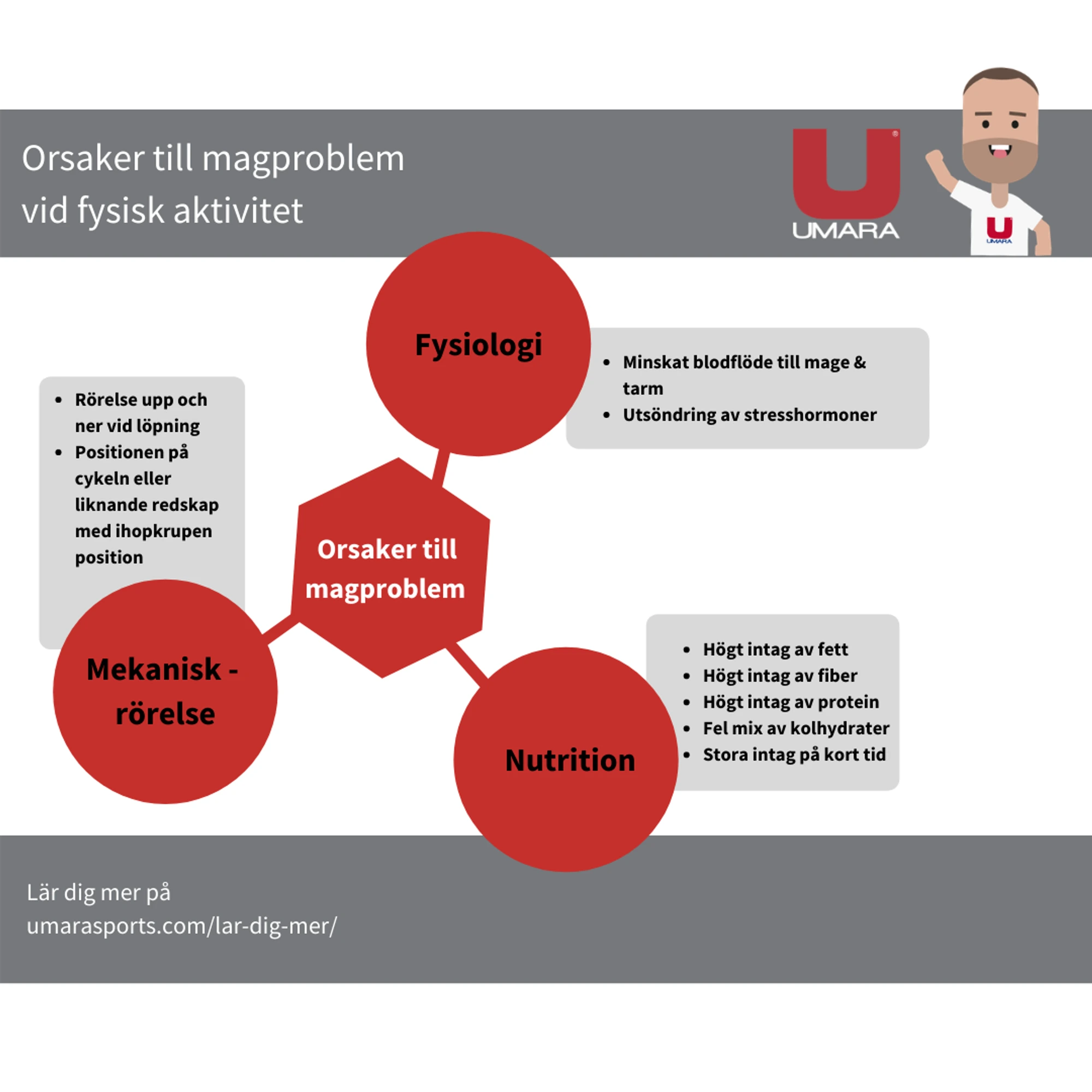
Posture has been shown to affect the occurrence of stomach problems. Runners often experience issues on the right and left sides at the lower part of the abdomen. Cyclists, on the other hand, are much more likely to experience problems up at the ribcage due to their sitting position. When a cyclist adopts an "aero position," the risk of stomach problems increases even further. This is primarily because the compression against the internal organs (stomach and intestines) increases.
Intensity
The majority of the earlier points are influenced by this factor. At high intensity, for example, it is difficult to sit properly on the bike, blood flow to the stomach is restricted more severely, and you become dehydrated more quickly. However, as we want to move forward as quickly as possible, this becomes a factor that is hard to manage.
Dehydration
It is becoming more widely accepted that a small loss of fluid does not affect your performance. It is normal to lose weight during activity, and it is often desirable. However, if you have a history of stomach issues, dehydration has been shown to irritate the intestines. Up to 3% dehydration seems not to affect either stomach emptying or absorption rates. But if fluid loss increases, it can negatively impact the stomach/intestines.
Pain Relievers / Analgesics
The idea that pain relievers should be avoided during training and competition because they "mask" the body's signals is probably not news. However, it is very common to take pain relievers during long-distance running (marathons and beyond). In a survey, it turned out that 60% of runners took painkillers during training sessions leading up to the race. During competition, as many as 70% took pain relievers (both before and during the race). Additionally, 25% of these individuals took a higher dose than what is recommended.
When as many as 89% of those running ultramarathons report stomach problems, it's not hard to draw a connection. Researchers have shown a 3-5 times increased risk of stomach issues when taking NSAIDs (non-steroidal anti-inflammatory drugs) like Ibuprofen and Ipren. This can simply be explained by the fact that pain relievers accelerate the "wear and tear" of the stomach and intestinal tract, just as regular activity does. It restricts blood flow, but in a more aggressive manner.
Caffeine
Although coffee itself does not directly cause stomach problems, the stimulant caffeine does have some effect on the stomach and intestines. Most of us feel the effects of coffee shortly after breakfast is consumed. Caffeine stimulates your autonomic nervous system, which controls smooth muscle. Smooth muscle is present in our intestinal walls and stomach, which are muscles we cannot control voluntarily. The stimulation of this smooth muscle by caffeine leads to the intestines speeding up and moving intestinal contents (feces, or chyme if you prefer to use the more medical terms) towards their final destination more quickly. Caffeine also increases adrenaline production, which in turn is linked to involuntary stomach emptying.
Depending on the dosage, this point ranks differently on the list. However, caffeine is probably not a significant contributing factor for the majority of us athletes. Remember that if your stomach feels uneasy during a competition, cut back on caffeine before you cut back on carbohydrates!
Genetics
A clear connection that has been observed is that if an athlete has a history of stomach problems, the risk of recurrence is high. Just as some people have an increased risk of headaches or cramps, some people are more prone to experiencing stomach issues. We are different individuals, and this significantly affects how resilient and sensitive we are.
However, genetics has a very small overall impact, and there's nothing to complain too much about. The major factors have been mentioned in earlier points, so focus on the aspects you can influence before blaming your parents for the genetic makeup you got ;).

Stomach issues are one of the major culprits for underperformance in many sports. Various reports indicate that as many as 70% (up to 90% in certain races) of us endurance athletes experience this to varying degrees. The most common symptoms among runners are stomach cramps and nausea, but vomiting and diarrhea also occur.
Even though research has intensified over the past 20 years, we are far from knowing everything about why the stomach acts up sometimes. Investigating the stomach/intestines during training is a challenge in itself, and there is still much to study to fully map out why we encounter problems. Let us now focus on what we know at this point that can cause stomach issues.
Factors that Increase the Risk of Stomach Problems
Reduced Blood Flow to the Stomach/Intestines
This is the primary reason why your stomach becomes more sensitive, which in turn increases the risk of problems. During physical exertion, blood flow is redirected to body parts that need extra oxygen. For cyclists or runners, this primarily means the muscles of the legs, the heart, and the lungs. But the skin also takes some extra blood in warmer climates to manage thermoregulation/cooling.
As much as 80-90% of blood flow is redirected from the internal organs to working muscles during intense exertion. This means that a large portion of the blood volume that usually surrounds the stomach/intestines diminishes, which results in a condition known as “ischemic colitis,” which occurs when damage or inflammation of the intestinal system arises due to impaired blood supply.
Practically speaking, impaired blood flow to the stomach and intestines means that the absorption rate of what you consume declines. This is true whether it’s water or some form of lighter energy like sports drinks. What significance does this have? When it comes to energy and fluids, it means that what you've consumed stays in the stomach longer and causes stomach cramps/nausea.
Overconsumption of Energy Before and During Activity
Even though stomach problems can arise without any intake of fluids or energy, it is indeed intake that has been pointed out as one of the major factors. What has the most significant impact is what takes time for the body to process. This includes fats, fibers, proteins, and high concentrations of carbohydrates. In 1999, a study was released measuring the absorption time for a small pizza (the size of a pan pizza) of about 600 kcal. The results show that it takes almost 6 hours for the body to complete the breakdown and absorb all the energy from it. The same amount of energy from fast carbohydrates takes about 1.5 hours. This illustrates how slow the absorption process is and how long our digestion continues after we’ve eaten, which requires a significant amount of blood.
During activity, researchers have also tested a smaller amount of energy (390 kcal) just before training. This was a smoothie consisting of 22g protein, 15g fat, and 41g carbohydrates. Quite a complex meal, in other words. This smoothie was sufficient for the runners, who ran 15 minutes on a treadmill, to experience increased blood flow to the stomach. The energy was complex enough that the blood flow to the muscles was hindered at moderate intensity. So even though blood flow is prioritized toward the muscles when the intensity increases—and this is when the risks of stomach problems significantly increase—it nonetheless shows that even at lower intensity, your performance is hindered if you have eaten too close to training.
Most of us consume only carbohydrates during training and competition, and if you’ve experienced a troubled stomach, you’re probably drinking/eating more than you can absorb at the moment. Even though adapted carbohydrates like maltodextrin are the easiest for the body to absorb, they can also cause issues if the intake is too large. The energy from the food you ate before training may still be in the processing stage, which should be taken into account when planning your intake during activity.