Solutions for stomach issues during physical activity
|
5.5 min reading
In last week's article, we went through the many different reasons why stomach problems can occur. But the most common reason is, of course, that you are taking in more energy than you can absorb, in a stomach that is particularly sensitive at the moment when blood is mainly flowing to your working muscles.
The simple solution is to take it easy with your energy intake. The downside is that fatigue will come faster and the quality of the workout decreases. You can get better at using both carbohydrates and fat as energy sources during activity, and this is something you can train to improve. I would like to say that no one has a "stomach of steel"; we are just more or less sensitive and more or less good at pushing our own limits. The important takeaway is that this limit is not set in stone but can be adjusted upward. Many can handle an energy intake of close to 1 gram of fat or around 2 grams of carbohydrates every minute during activity without their stomachs failing them. There is no reason to believe that you cannot reach the same limit if you give it time and gradually train your absorption through small increases over time. Don’t forget to consider all the factors that affect you and adjust those you can if you have stomach issues. Below follows a review of solutions to counteract stomach problems.
The simple solution is to take it easy with your energy intake. The downside is that fatigue will come faster and the quality of the workout decreases. You can get better at using both carbohydrates and fat as energy sources during activity, and this is something you can train to improve. I would like to say that no one has a "stomach of steel"; we are just more or less sensitive and more or less good at pushing our own limits. The important takeaway is that this limit is not set in stone but can be adjusted upward. Many can handle an energy intake of close to 1 gram of fat or around 2 grams of carbohydrates every minute during activity without their stomachs failing them. There is no reason to believe that you cannot reach the same limit if you give it time and gradually train your absorption through small increases over time. Don’t forget to consider all the factors that affect you and adjust those you can if you have stomach issues. Below follows a review of solutions to counteract stomach problems.
Posture and Movement Economy
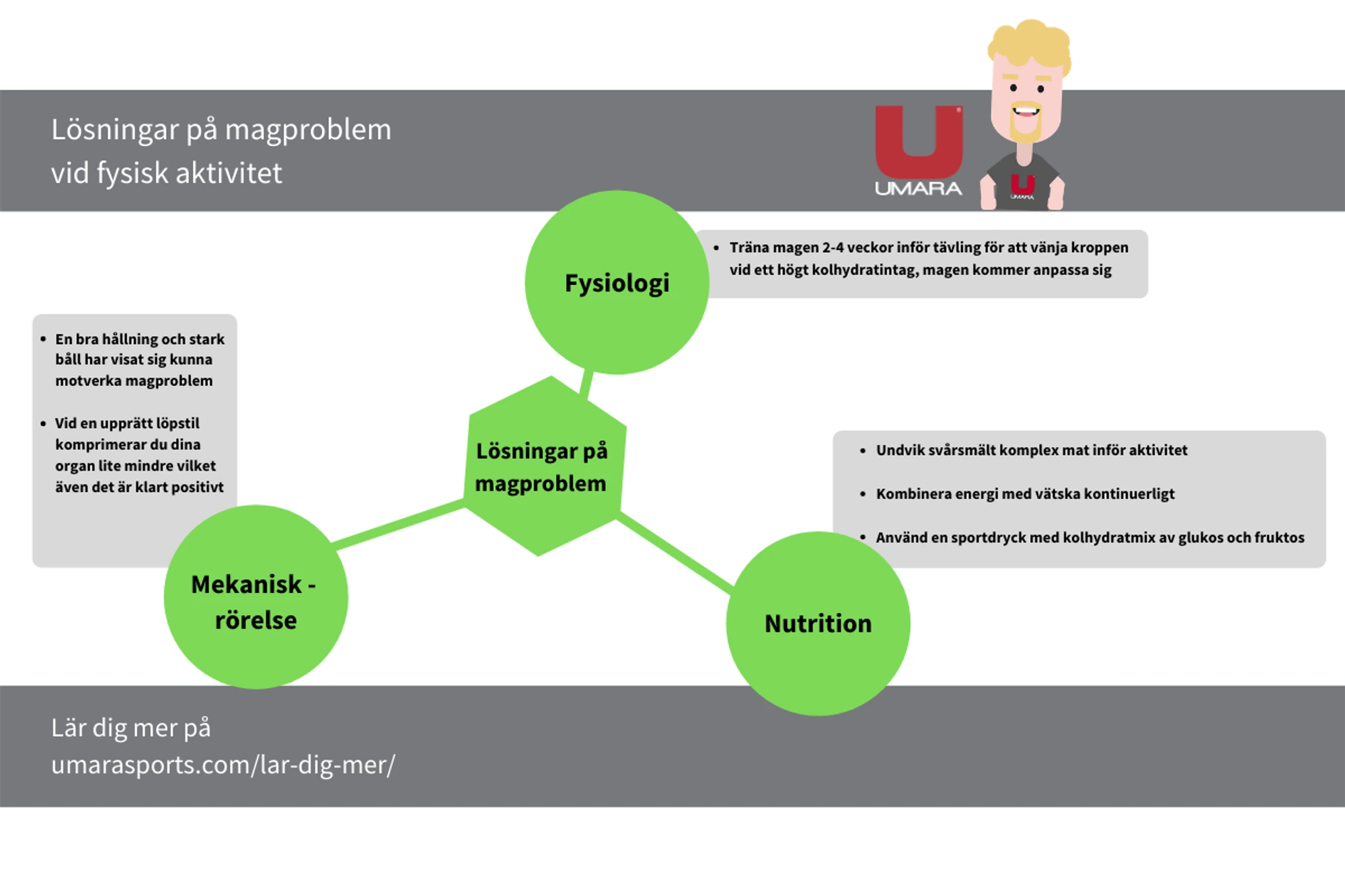
A couple of studies have shown that improved and more upright posture while running can reduce problems. A softer and more fluid running stride leads to lower mechanical load due to less impact. Doing some core stabilizing training to increase the tone of the deep core muscles can also help reduce movements in the abdominal area, which is positive. If you keep your hips forward and have a more upright running style, you compress your organs a little less, which is clearly a positive aspect.
Stay Hydrated
If you, as an athlete, tend to become dehydrated easily, it has been shown that drinking a sports drink with a lighter concentration helps with fluid absorption. This is because the salts assist with fluid transport and every little carbohydrate draws in fluid through its own absorption into the blood. If you don't want to consume energy for any reason, a saline solution is the next best way to hydrate the body. Otherwise, the basic principle is to drink according to thirst. If it gets really hot (+25 degrees) and you are training/competing at high intensity, a structured fluid intake of around 1 liter of fluid/hour can be important to keep your stomach calm.
Train Strategically Regarding Energy
It may sound like common sense, but not everyone does it. It has been well-researched and shown that those who train strategically with the same energy setup that they then use during competition experience much fewer stomach problems during the actual event. More effective absorption also means less stomach issues.
Continuously Combine Energy with Fluid
Consume energy along with fluid. This becomes increasingly important as you become more dehydrated due to sweat loss. Drink little and often for a continuous flow of fluid and energy. Avoid larger and dispersed intakes as it can be too much for the stomach to handle at once, as well as a larger volume of fluid sloshing around in the stomach, causing irritation.
Avoid Painkillers / Analgesics
Avoid painkillers unless you have a medical reason that requires you to use them. Many athletes use painkillers preventively, but with a 3-5 times higher risk of stomach issues, one must have a very stable stomach to even consider the pills.
Plan Your Caffeine Intake
It is very popular to take caffeine late in races as it makes you feel more awake, but we want to discourage this if you have a history of stomach problems. It is better to take it before the race since caffeine has a half-life of 5 hours in the blood. If you are going to perform longer races, make sure to monitor your caffeine intake to around 40-50mg/hour, which corresponds to half a cup of coffee.
A couple of studies have shown that improved and more upright posture while running can reduce problems. A softer and more fluid running stride leads to lower mechanical load due to less impact. Doing some core stabilizing training to increase the tone of the deep core muscles can also help reduce movements in the abdominal area, which is positive. If you keep your hips forward and have a more upright running style, you compress your organs a little less, which is clearly a positive aspect.
Stay Hydrated
If you, as an athlete, tend to become dehydrated easily, it has been shown that drinking a sports drink with a lighter concentration helps with fluid absorption. This is because the salts assist with fluid transport and every little carbohydrate draws in fluid through its own absorption into the blood. If you don't want to consume energy for any reason, a saline solution is the next best way to hydrate the body. Otherwise, the basic principle is to drink according to thirst. If it gets really hot (+25 degrees) and you are training/competing at high intensity, a structured fluid intake of around 1 liter of fluid/hour can be important to keep your stomach calm.
Train Strategically Regarding Energy
It may sound like common sense, but not everyone does it. It has been well-researched and shown that those who train strategically with the same energy setup that they then use during competition experience much fewer stomach problems during the actual event. More effective absorption also means less stomach issues.
Continuously Combine Energy with Fluid
Consume energy along with fluid. This becomes increasingly important as you become more dehydrated due to sweat loss. Drink little and often for a continuous flow of fluid and energy. Avoid larger and dispersed intakes as it can be too much for the stomach to handle at once, as well as a larger volume of fluid sloshing around in the stomach, causing irritation.
Avoid Painkillers / Analgesics
Avoid painkillers unless you have a medical reason that requires you to use them. Many athletes use painkillers preventively, but with a 3-5 times higher risk of stomach issues, one must have a very stable stomach to even consider the pills.
Plan Your Caffeine Intake
It is very popular to take caffeine late in races as it makes you feel more awake, but we want to discourage this if you have a history of stomach problems. It is better to take it before the race since caffeine has a half-life of 5 hours in the blood. If you are going to perform longer races, make sure to monitor your caffeine intake to around 40-50mg/hour, which corresponds to half a cup of coffee.
Avoid heavy complex meals prior to activity
Close to the race, your stomach should be as calm as possible. The recommendation is to avoid heavy food, especially fats, fibers, and proteins, in the 2-3 hours before training or competition. This is because your nutrient absorption in the small intestine is reduced by up to 80% during exercise compared to a resting state. Do not draw parallels between energy intake at rest and energy intake during performance, as your body's functionality differs between these two states. Feeling comfortably full and satisfied with a calm stomach after a lunch of scrambled eggs with broccoli or a bowl of whole grain porridge with a little milk and berries does not mean it will be the same during exercise.
During activity, the advice is to consume simple, easily absorbed carbohydrates that the body can quickly break down and utilize. It has been shown that the body does not differentiate between gels and sports drinks. What matters is the number of grams of carbohydrates. If you want to combine the intake of gels, bars, and sports drinks, it is suggested to take gels and bars at the beginning when you have a good hydration balance in your body, if possible. Then shift towards a larger proportion of sports drinks towards the end of the competition when you have been sweating longer and become thirstier.
Experience
With experience comes wisdom and fewer stomach problems. Interestingly, stomach issues have been shown to decrease with age. It is believed to be partly due to the fact that we become better adapted to our activity while the technique becomes "stiffer" and less mechanically stressful. The stomach and intestines are not athletic organs and cannot be trained in the same way as muscles. However, training over time has been shown to improve blood flow to the stomach and intestines. A well-trained person has better blood flow to the stomach and intestines during activity compared to an untrained person and can therefore handle a higher energy intake more efficiently.
Close to the race, your stomach should be as calm as possible. The recommendation is to avoid heavy food, especially fats, fibers, and proteins, in the 2-3 hours before training or competition. This is because your nutrient absorption in the small intestine is reduced by up to 80% during exercise compared to a resting state. Do not draw parallels between energy intake at rest and energy intake during performance, as your body's functionality differs between these two states. Feeling comfortably full and satisfied with a calm stomach after a lunch of scrambled eggs with broccoli or a bowl of whole grain porridge with a little milk and berries does not mean it will be the same during exercise.
During activity, the advice is to consume simple, easily absorbed carbohydrates that the body can quickly break down and utilize. It has been shown that the body does not differentiate between gels and sports drinks. What matters is the number of grams of carbohydrates. If you want to combine the intake of gels, bars, and sports drinks, it is suggested to take gels and bars at the beginning when you have a good hydration balance in your body, if possible. Then shift towards a larger proportion of sports drinks towards the end of the competition when you have been sweating longer and become thirstier.
Experience
With experience comes wisdom and fewer stomach problems. Interestingly, stomach issues have been shown to decrease with age. It is believed to be partly due to the fact that we become better adapted to our activity while the technique becomes "stiffer" and less mechanically stressful. The stomach and intestines are not athletic organs and cannot be trained in the same way as muscles. However, training over time has been shown to improve blood flow to the stomach and intestines. A well-trained person has better blood flow to the stomach and intestines during activity compared to an untrained person and can therefore handle a higher energy intake more efficiently.
Summary
– Train the core.
– Train some sessions with the same energy setup as during competition.
– Increase energy intake through small increases from session to session.
– Avoid painkillers.
– No solid food 3 hours before training/competition and low fiber and fat intake in the last 2 days before the competition.
– Drink a little and often, regardless of whether it is sports drink or plain water.
– Review your running technique.
Good luck with the challenges of the fall!