
Weight and Performance Part 1/2
Body weight affects athletic performance more than many are willing to acknowledge, especially in sports where you have to move your own body. In this article, we'll explore the fundamentals of weight loss: why fat is stored, what a negative energy balance really entails, and where body fat goes when you shed pounds. How does weight reduction work physiologically, and why is it rarely completely linear in practice? The truth is straightforward but challenging: to lose fat, you must maintain a long-term energy deficit, while ensuring your energy levels aren't so low that they negatively affect health, recovery, and performance.
Why Weight Affects Performance
When it comes to sports performance, body weight is a crucial piece of the puzzle. Roughly speaking, we can assume that transporting each kilo of body mass costs ~1 kcal to transport 1 km when running. This figure is fairly independent of speed; what changes is the substrate distribution, with more carbohydrates being burned at higher intensity. This is something we've touched on in several articles before, so we'll skip the detailed deep dive here.
If you weigh 80 kg, it costs about 80 kcal/km to move your body when running. If you lose 4 kg, you thereby consume approximately 76 kcal/km – which is about 5% more energy-efficient. With the same oxygen uptake, often expressed in liters of oxygen per kg body weight per minute, you can run roughly 5% faster at the same energy cost, provided you're equally energy-efficient at that speed. This equates to about 5 minutes on a half marathon (1:45–1:40) or about 10 minutes on a marathon. A difference significant enough that we believe body weight is at least worth considering if your goal is firmly set.
The fact that lower weight is cheaper to move is not sensational news. You might already pay extra for a light shoe or for shaving off a few grams on the bike frame – aaah, see what I did there ;). This article will not tell you exactly which weight is right for you or which diet is "best" for weight loss. Instead, we'll go through the theory behind weight loss, the basics. In part two, we'll then cover practice and more concrete tips.
Fat Storage and Energy Currency
Before we can lose weight, we need to have some body mass to lose. Most often, it's body fat that we want to get rid of, as it is largely "dead weight" that takes oxygen to transport. Elite athletes usually have around 8% body fat during the competitive season (6% for males, 10% for women) because body fat is mostly unnecessary weight.
The body stores excess energy as triglycerides: small fat cores in specific fat cells (adipocytes). These are what we want to reduce by maintaining a calorie deficit/energy deficit. Humans do not directly consume calories; calories are a unit of energy: 1 kcal = 4.184 kJ - the amount of energy required to heat 1 gram of water by 1 degree Celsius (from 14.5 to 15.5) at 1 atmosphere pressure. An excess of energy, measured in kilocalories, leads to an increase in the body's energy mass, which means storing fat.
Negative Energy Balance in Practice
This is the foundation. As physical beings composed of atoms, we are bound by the laws of physics. Energy cannot be created or destroyed; it can only be converted between different forms. If we expend more energy than we consume, we experience a negative energy balance, and vice versa. The energy then transforms from stored mass (like a spare tire) to kinetic energy when we run. This process is known as energy conversion.
A kilogram of body fat contains approximately 7,500–7,800 kcal. Pure fat (pure triglyceride) is about 9,000 kcal/kg, but a kilogram of stored body fat also contains water, connective tissue, and other components, which reduce its energy density. A kilo of fat also takes up more volume than a kilo of muscle. So, even if your weight remains the same, having more muscle and less fat often makes you more aerodynamic, or "compact," reducing air resistance.
If you aim to shed 5 kg of body fat, you'll need to burn about 37,500 kcal (7,500 × 5). With a deficit of 500 kcal/day, it would take roughly 75 days, or about 2.5 months. Practically, you don't need to maintain a deficit every single day. You can align your energy balance with your training schedule (more on that in the next article), but overall, over time, the energy balance should result in a deficit.
Why Weight Loss Isn't Linear
It's important to remember that you can also experience relative energy deficiency, a condition where your body deprioritizes normal functions to conserve energy. This can, in turn, change your total energy expenditure. A calorie intake that previously resulted in weight loss might no longer be effective because the body reduces expenditure, such as by suspending menstruation, which is not uncommon among athletic women at higher levels. Remember: weight loss is never linear.
There's a valuable review that examines energy expenditure and its variations during weight loss. Check it out if you want to learn more. It demonstrates, among other things, that for individuals with a BMI over 28, about a 5,000 kcal deficit is needed to lose one kilo of fat, but after four weeks, a deficit of around 7,800 kcal per kilo is required. The body becomes more energy-efficient and doesn't "waste" energy the same way when you're in a deficit. That's one reason why your weight loss should be finalized before the competition season kicks off.
Energy doesn't disappear – it transforms
The atoms in the body have a definite mass. You might remember the periodic table from chemistry classes; we focus on carbon, hydrogen, and oxygen as they are the building blocks of body fat.
An approximate average value for the chemical formula of stored fat (triglyceride, with variation in fatty acid chains) is C55H104O6. That is, 55 carbon, 104 hydrogen, and 6 oxygen. This is the body in its most molecular and mundane form. These carbon, hydrogen, and oxygen compounds are what we want to eliminate, but how does that happen?
Where does the fat go?
The quick answer: largely through exhaled air and urine. When researchers tracked how fat moves from storage in fat cells to disappearing, they found that about 84% is converted to carbon dioxide and 16% is excreted as water (H2O). To lose 5 kg, you'll need a substantial amount of oxygen to oxidize the fat, and you'll produce a significant amount of carbon dioxide along the way. Ultimately, the weight of what leaves your body will be identical to the weight you've lost. Energy isn't created out of thin air and doesn't vanish—it changes form. Your 5 kg leaves the body as approximately 4.2 kg of carbon dioxide and around 0.8 kg of water.
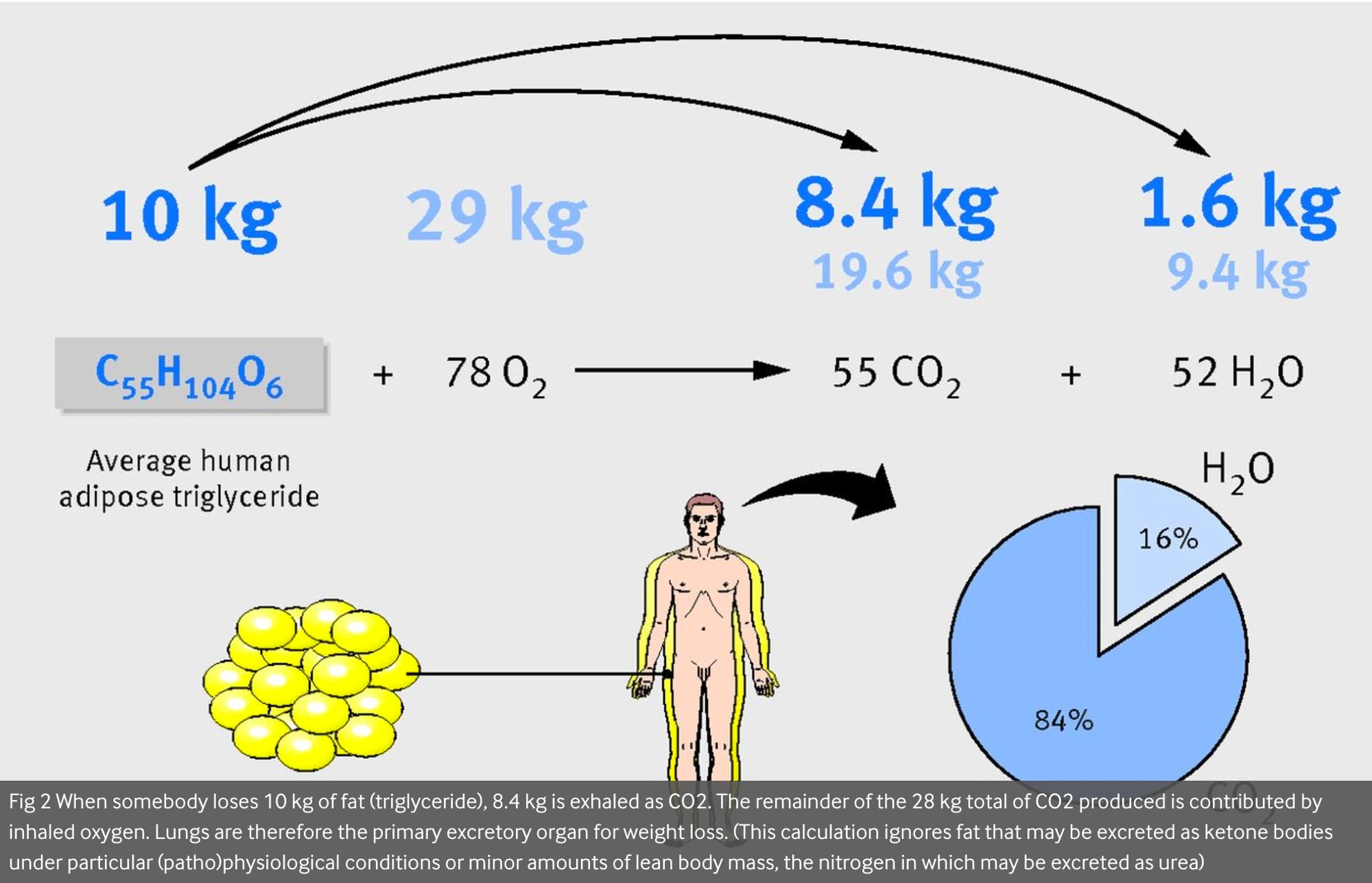
If you know your oxygen uptake, you can practically calculate how much training is needed to "burn" 1 kg of fat, provided you are in energy balance without the training. Remember that this is theory: satiety, hormones, and behavior make the equation significantly more complex in practice.
Example and Bridge to Part 2
In the next article, we delve more into practical details and what the theory actually means. Here's an example where we use Vätternrundan as a fun exercise.
Watts, Calories, and Efficiency on the Bike
If we know our efficiency, we can theoretically convert calorie intake into watts on the pedals. Watt is the measure of work per unit of time: 1 watt = 1 joule per second. Feel free to try this converter if you want to play with the numbers. Note that it only converts between, for example, work in watts and calories, as efficiency isn't included in the conversion.
Let's do some calculations on Vätternrundan:
According to the energy calculator, you burn about 750 kcal/hour if you cycle in a group and plan to go around the lake in about 8 hours. According to the converter, 750 kcal/hour corresponds to approximately 872 watts in terms of metabolic power (1 kcal ≈ 4,184 J).
On a bike, you often have an efficiency of around 20–25%, which means that the mechanical power at the pedals will be about 20–25% of the metabolic power. With 872 W metabolic power, this gives a mechanical power of approximately 175–218 W (872 × 0.20 ≈ 175 W; 872 × 0.25 ≈ 218 W). In short: your muscles work hard to generate work that corresponds to the mechanical power, while the calories are the fuel in the tank. These calories are released through ATP, which is the body's immediate energy currency (but that's a whole other article).
With better efficiency – through better aerodynamics, lower weight, and such – you get more watts per consumed calorie and should, assuming that tires, chain, and everything else work, get to the finish line faster.
Everything we eat contains energy (no, negative calories do not exist). If we eat more than we burn, the surplus is stored. Fat has the best efficiency for storage, followed by carbohydrates and finally protein. Practically, this means that fat is the easiest for the body to store since it's already in the right format. Carbohydrates and protein must be converted into fat (de novo lipogenesis) to be stored, and this process requires energy (approximately 25% of the energy in carbohydrates is converted into heat in this process according to the mentioned source). But in practice, a high-fat diet can absolutely work for weight loss, it's just one of many methods to ultimately create a negative energy balance.
“The conversion of CHO into fat is a high energy-requiring process as compared to the direct storage of exogenous fat as body fat. About 25% of the energy content of CHOs is converted into heat, whereas the deposition of dietary triglycerides into adipose tissue requires only about 2% energy.”
Now you have completed part 1 – it's time for part 2.